
ECB-IMG-208683
Echinobase Image ID: 208683
|
|
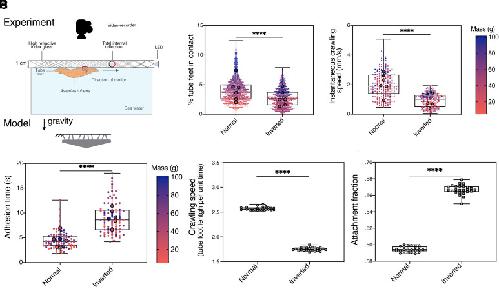
Fig. 6. Modulation of adhesion time enables A. rubens to adapt its locomotion under inverted conditions. (A) Schematic of the experimental setup for inverted locomotion. Sea stars were allowed to crawl upside down, while their oral surface was recorded from above using a camera positioned over the aquarium. (B) Percentage of tube feet in contact, (C) instantaneous crawling speed, and (D) tube foot adhesion time for normal versus inverted conditions (N = 6 sea stars per condition). All data are displayed as superplots, showing individual data points. Each dot corresponds to an individual contact event, and large dots indicate means per individual. Each individual was tested in three replicates. (E) Simulated crawling speed and (F) attachment fraction τ=∑i=1NTiattached/NT, defined as the sum over all tube feet of the time Tiattached each foot spends in attachment, divided by the total simulation time T times the number N of tube feet. Both shown for the flat and inverted sea stars. For each orientation, 25 random simulations have been performed. Parameter values are N=100,L=40,l=1,Fmax=0.4,λ=5, with no parameter adjustment between normal and inverted simulations. ****P < 0.0001. Image published in: Deridoux A et al. (2026) Image downloaded from an Open Access article in PubMed Central. Copyright © 2026 the Author(s). Published by PNAS. Larger Image Printer Friendly View |