
ECB-IMG-208662
Echinobase Image ID: 208662
|
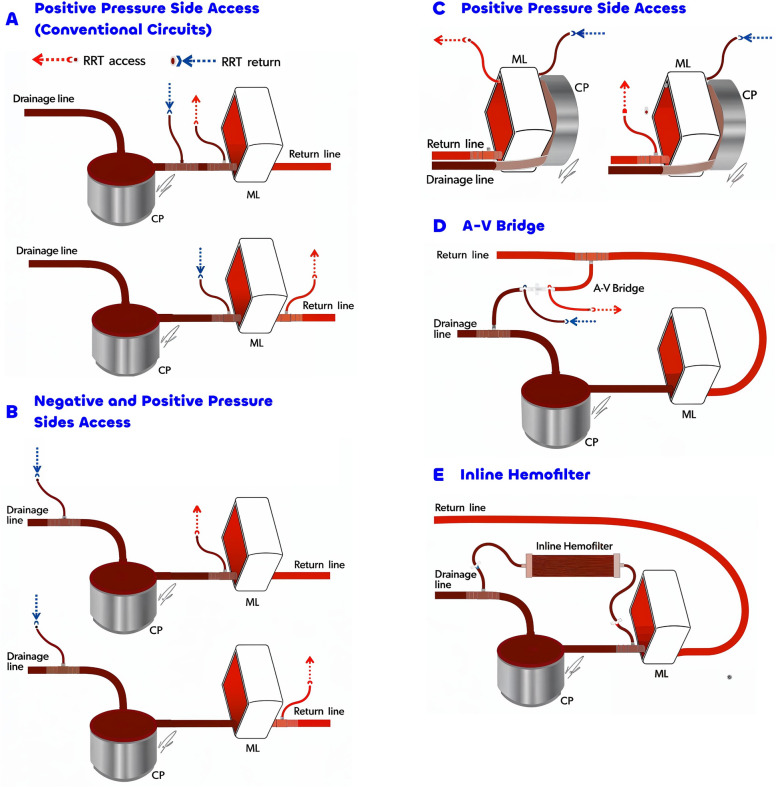
Fig. 3. Summary of spectrum of configurations for continuous renal replacement therapy (CRRT) during extracorporeal membrane oxygenation (ECMO). A Connection of a RRT circuit to a conventional ECMO circuit, with inflow from a positive pressure side, before (top) or after (bottom) the membrane lung (ML), with outflow directed to another positive pressure side (pre-ML). The proposed configuration of drawing blood after the ML and returning it to pre-ML is safety. Returning blood from the RRT circuit before the ML takes advantage of the hollow fiber ML to trap bubbles, air, clots and other particulate matter that may be derived from the CRRT circuit, preventing them from reaching the patient’s circulation, and is particularly relevant in VA ECMO. ECMO recirculation would be expected to be minimal, (approximately 2–3% in a patient receiving 3-5 L/min of flow) that would not necessarily impact the effectiveness of the ML. It should be acknowledged, that in certain circumstances of severe refractory hypoxemia, the ML effectiveness may be reduced, but this could be mitigated by a small increase in extracorporeal blood flow (compensating for the CRRT flow). In addition, it should be considered that returning the blood from the CRRT circuit post-ML will induce a shunt effect with a small volume of blood returning to the patient without passing through the ML, which could lead to a similar effect as increasing the recirculation fraction and decreased oxygenator efficiency. CRRT recirculation would also be expected to be negligible (0.2 L/min of flow vs 5 L/min) and not affect clearance. B Connection of a CRRT circuit to a conventional ECMO circuit, with inflow from a positive pressure side, before (top) or after (bottom) the ML, with outflow directed to the negative pressure side (pre-pump) in both cases. C Connection of a CRRT circuit to ECMO circuits with the pump head directly connected to the ML, with no access available between the two components. On the left, inflow from the top of the arterial side of the ML to the top of the venous side; on the right, inflow from the tubing exiting the ML to the top of the venous side. D Connection of a CRRT circuit through an arterio-venous (A-V) bridge (or shunt) between the return and drainage tubing. This configuration is frequently used in neonatal and pediatric ECMO allowing for continued recirculation within the ECMO circuit and in instances of weaning trials (clamping the return and drainage tubing) and during low flow states to reduce the risk of circuit thrombosis (the drainage and return tubing are kept open). E In-line pumpless hemofilter relying on the pressure gradient between a positive pressure (post-pump) and a negative pressure (pre-pump) side of the circuit. Panels B, D, E demonstrate the return of CRRT to the negative pressure side of the circuit. It should be noted that while discouraged because of the risk of air bring sucked into the blood pump, this is a common configuration in neonatal and pediatric patients and should only be considered when other options are not available. To reduce risk, integrating bubble sensors on the drainage line after the site of the CRRT circuit connection, and on the post-ML side of the circuit allows for early detection of the presence of air, thus reducing the risk of air embolism. Abbreviations: A-V, arterio-venous; CP, centrifugal pump; ML, membrane lung; CRRT, continuous renal replacement therapy Image published in: Gist KM et al. (2026) Image downloaded from an Open Access article in PubMed Central. © The Author(s) 2026 Larger Image Printer Friendly View |