Click
here to close Hello! We notice that
you are using Internet Explorer, which is not supported by Echinobase
and may cause the site to display incorrectly. We suggest using a
current version of Chrome,
FireFox,
or Safari.
Proc Biol Sci
2022 Jan 26;2891967:20211697. doi: 10.1098/rspb.2021.1697.
Show Gene links
Show Anatomy links
Southeast Alaskan kelp forests: inferences of process from large-scale patterns of variation in space and time.
Gorra TR, Garcia SCR, Langhans MR, Hoshijima U, Estes JA, Raimondi PT, Tinker MT, Kenner MC, Kroeker KJ.
???displayArticle.abstract???
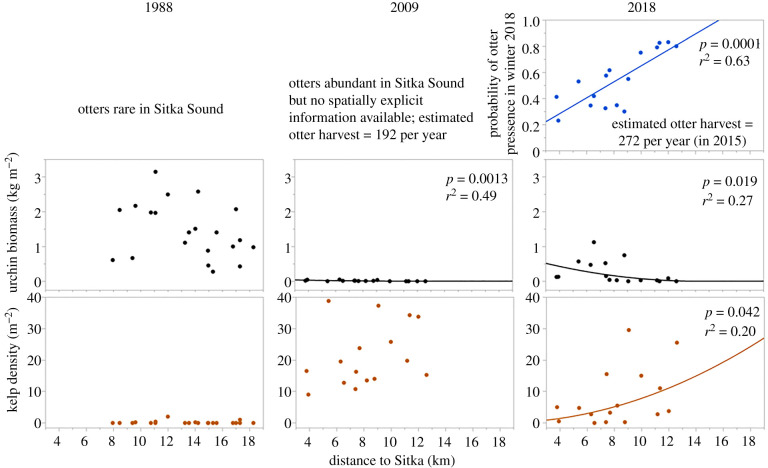
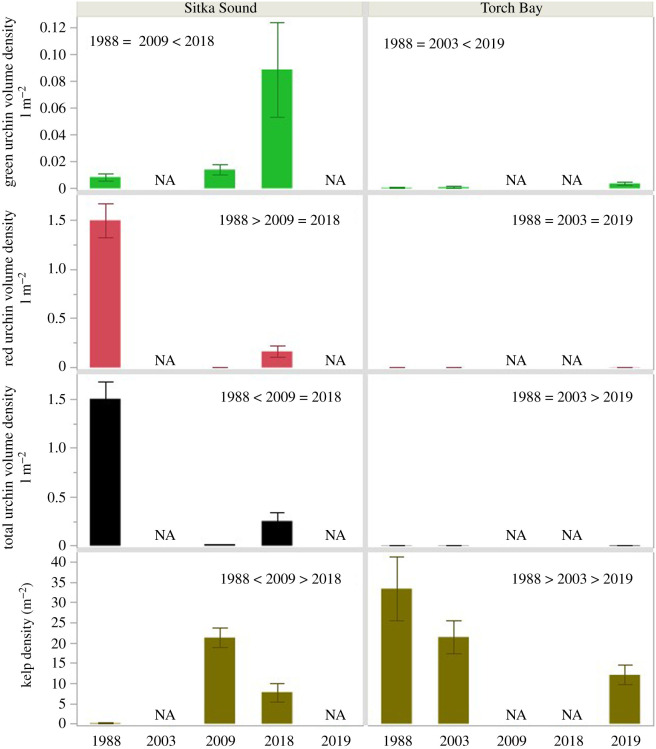
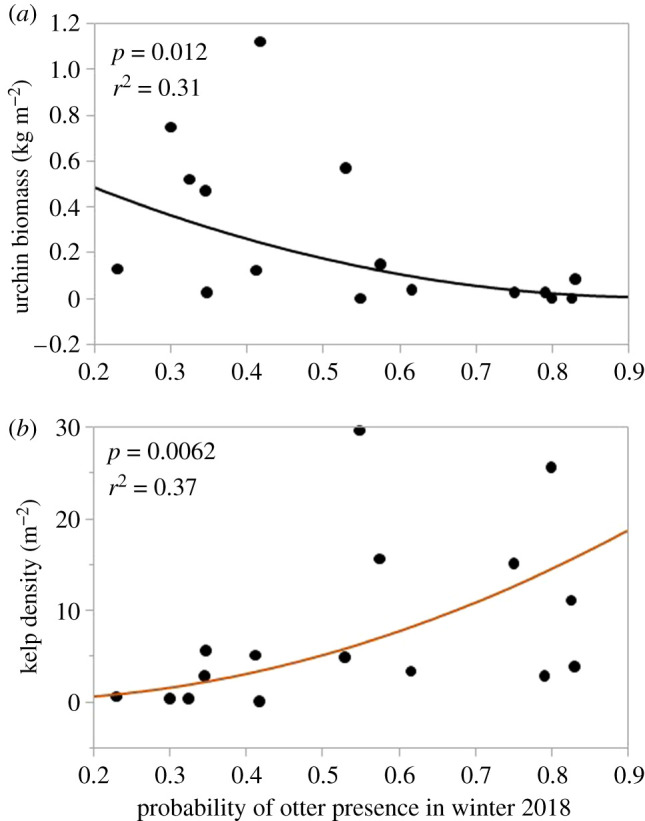
Humans were considered external drivers in much foundational ecological research. A recognition that humans are embedded in the complex interaction networks we study can provide new insight into our ecological paradigms. Here, we use time-series data spanning three decades to explore the effects of human harvesting on otter-urchin-kelp trophic cascades in southeast Alaska. These effects were inferred from variation in sea urchin and kelp abundance following the post fur trade repatriation of otters and a subsequent localized reduction of otters by human harvest in one location. In an example of a classic trophic cascade, otter repatriation was followed by a 99% reduction in urchin biomass density and a greater than 99% increase in kelp density region wide. Recent spatially concentrated harvesting of otters was associated with a localized 70% decline in otter abundance in one location, with urchins increasing and kelps declining in accordance with the spatial pattern of otter occupancy within that region. While the otter-urchin-kelp trophic cascade has been associated with alternative community states at the regional scale, this research highlights how small-scale variability in otter occupancy, ostensibly due to spatial variability in harvesting or the risk landscape for otters, can result in within-region patchiness in these community states.
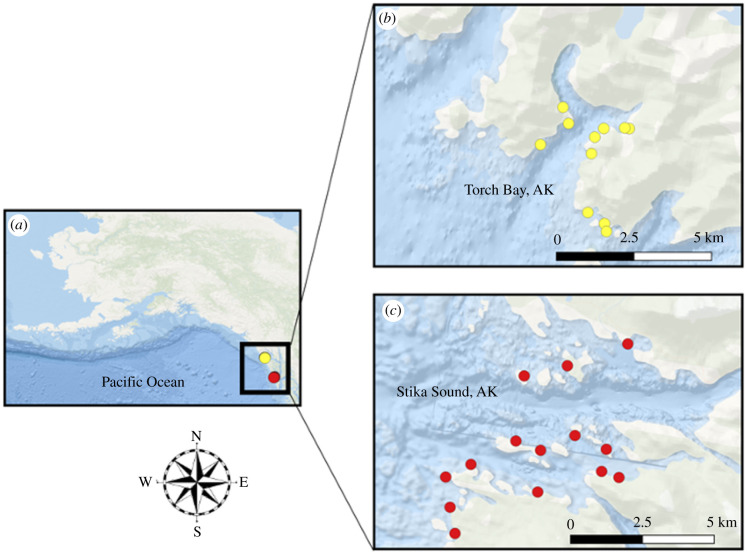
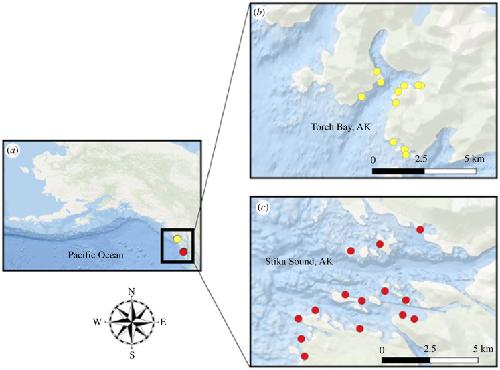
Figure 1. . Map of study area showing location of Torch Bay (northern site, yellow) and Sitka Sound (southern site, red) (a), as well as sites sampled across the latter two time periods (2003/2009 versus 2018/2019, respectively) in each location (b and c). The maps only display sites from the latter two sampling periods. (Online version in colour.)
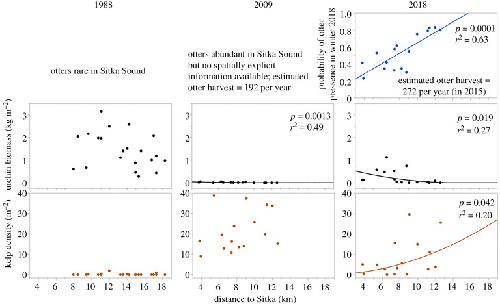
Figure 2. . Patterns of variation with distance over time from the town of Sitka for sea otter abundance index, urchin biomass density and kelp density. The line indicates a significant linear (2018 otters) or nonlinear relationship with distance from Sitka. With the exception of the relationship between the distance to the town of Sitka and the probability of otter presence, all analyses shown here were performed on square-transformed data. (Online version in colour.)
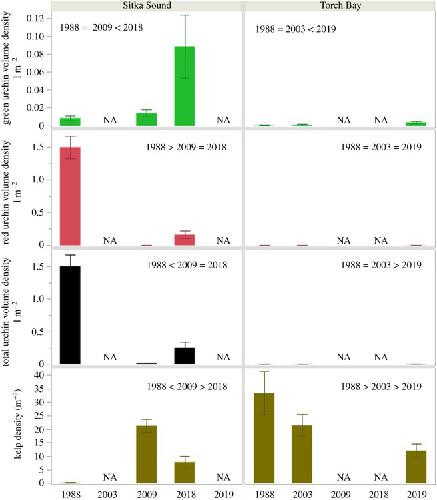
Figure 3. . Variation in abundance of sea urchins and kelp in Sitka Sound and Torch Bay among the years. Green = Strongylocentrotus droebachiensis, Red = Mesocentrotus franciscanus, Black = total urchin biomass density, Brown = Laminariales. Inset year comparison is from ANOVA/TUKEY analyses. (Online version in colour.)
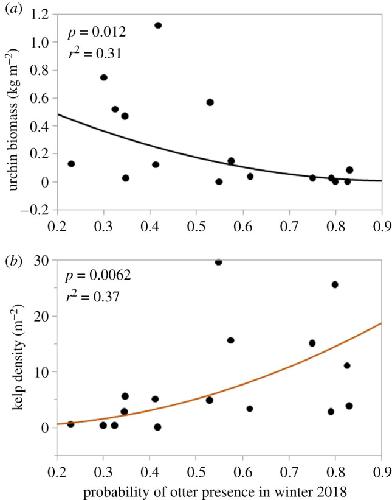
Figure 4. . Functional relationships between urchin biomass density (a) and kelp density (b) as a function of the probability of seeing an otter in Sitka Sound in 2018. (Online version in colour.)
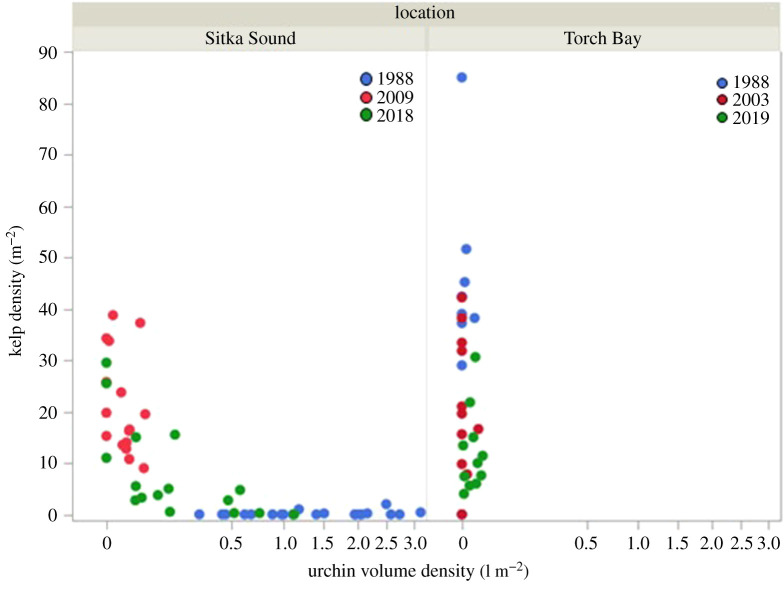
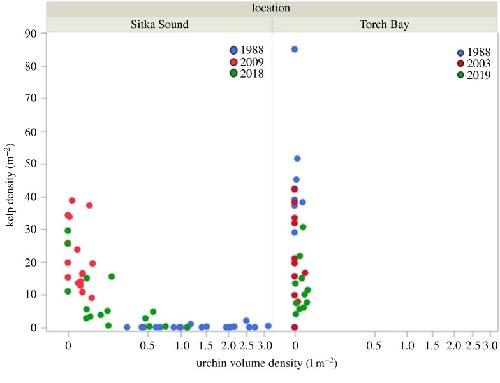
Figure 5. . State space plots of total urchin biomass density versus kelp density by sample sites for Sitka Sound and Torch Bay among the years these areas were sampled. (Online version in colour.)
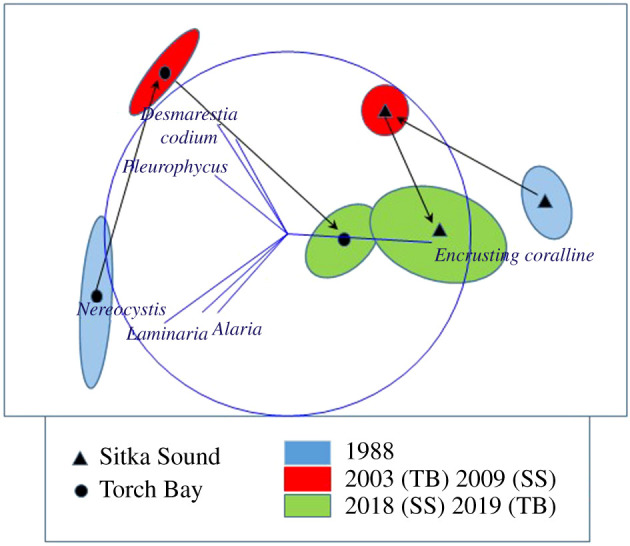
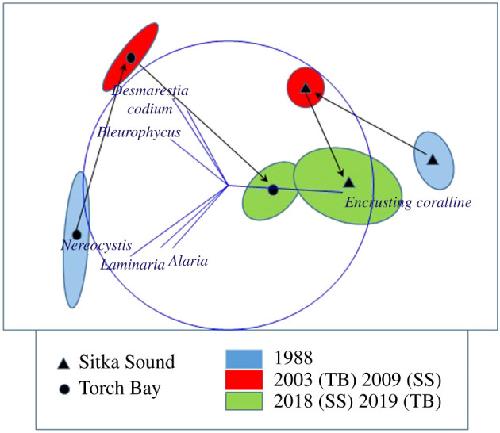
Figure 6. . Non-metric multidimensional scaling plot of the centroids and 80% confidence ellipses for benthic community structure for Sitka Sound and Torch Bay based on the broad taxonomic and functional groups. Black arrows depict the temporal trajectory of the communities at each location (1988 to 2003 (TB) or 2009 (SS) to 2018). Blue vectors indicate the region of the graph with greater abundances of indicated species. (Online version in colour.)
Boivin,
Ecological consequences of human niche construction: Examining long-term anthropogenic shaping of global species distributions.
2016, Pubmed
Boivin,
Ecological consequences of human niche construction: Examining long-term anthropogenic shaping of global species distributions.
2016,
Pubmed Breed,
Predicting animal home-range structure and transitions using a multistate Ornstein-Uhlenbeck biased random walk.
2017,
Pubmed Burt,
Sudden collapse of a mesopredator reveals its complementary role in mediating rocky reef regime shifts.
2018,
Pubmed
,
Echinobase Dunne,
The roles and impacts of human hunter-gatherers in North Pacific marine food webs.
2016,
Pubmed Estes,
Costs and benefits of living with predators.
2020,
Pubmed Estes,
Sea otters: their role in structuring nearshore communities.
1974,
Pubmed Estes,
Predicting and detecting reciprocity between indirect ecological interactions and evolution.
2013,
Pubmed Gaynor,
Landscapes of Fear: Spatial Patterns of Risk Perception and Response.
2019,
Pubmed Gregr,
Cascading social-ecological costs and benefits triggered by a recovering keystone predator.
2020,
Pubmed Hessing-Lewis,
Ecosystem features determine seagrass community response to sea otter foraging.
2018,
Pubmed Hewson,
Densovirus associated with sea-star wasting disease and mass mortality.
2014,
Pubmed
,
Echinobase Lewontin,
The meaning of stability.
1969,
Pubmed Markel,
Indirect effects of sea otters on rockfish (Sebastes spp.) in giant kelp forests.
2015,
Pubmed
,
Echinobase Rasher,
Keystone predators govern the pathway and pace of climate impacts in a subarctic marine ecosystem.
2020,
Pubmed Rechsteiner,
Sex and occupation time influence niche space of a recovering keystone predator.
2019,
Pubmed
,
Echinobase Ripple,
What is a Trophic Cascade?
2016,
Pubmed Singh,
Sea otters homogenize mussel beds and reduce habitat provisioning in a rocky intertidal ecosystem.
2013,
Pubmed
,
Echinobase Slade,
Archaeological and Contemporary Evidence Indicates Low Sea Otter Prevalence on the Pacific Northwest Coast During the Late Holocene.
2022,
Pubmed Stewart,
Testing the nutritional-limitation, predator-avoidance, and storm-avoidance hypotheses for restricted sea otter habitat use in the Aleutian Islands, Alaska.
2015,
Pubmed Tarjan,
Permissible Home Range Estimation (PHRE) in Restricted Habitats: A New Algorithm and an Evaluation for Sea Otters.
2016,
Pubmed Tinker,
Using demography and movement behavior to predict range expansion of the southern sea otter.
2008,
Pubmed Worm,
Humans as a Hyperkeystone Species.
2016,
Pubmed