Click
here to close Hello! We notice that
you are using Internet Explorer, which is not supported by Echinobase
and may cause the site to display incorrectly. We suggest using a
current version of Chrome,
FireFox,
or Safari.
PLoS One
2020 Jan 01;152:e0228893. doi: 10.1371/journal.pone.0228893.
Show Gene links
Show Anatomy links
Changes in the proteome of sea urchin Paracentrotus lividus coelomocytes in response to LPS injection into the body cavity.
Inguglia L, Chiaramonte M, Arizza V, Turiák L, Vékey K, Drahos L, Pitonzo R, Avellone G, Di Stefano V.
???displayArticle.abstract???
BACKGROUND: The immune system of echinoderm sea urchins is characterised by a high degree of complexity that is not completely understood. The Mediterranean sea urchin Paracentrotus lividus coelomocytes mediate immune responses through phagocytosis, encapsulation of non-self particles, and production of diffusible factors including antimicrobial molecules. Details of these processes, and molecular pathways driving these mechanisms, are still to be fully elucidated.
PRINCIPAL FINDINGS: In the present study we treated the sea urchin P. lividus with the bacterial lipopolysaccharide (LPS) and collected coelomocytes at different time-points (1, 3, 6 and 24 hours). We have shown, using label-free quantitative mass spectrometry, how LPS is able to modulate the coelomocyte proteome and to effect cellular pathways, such as endocytosis and phagocytosis, as soon as the immunomodulating agent is injected. The present study has also shown that treatment can modulate various cellular processes such as cytoskeleton reorganisation, and stress and energetic homeostasis.
CONCLUSIONS: Our data demonstrates, through mass spectrometry and the following functional annotation bioinformatics analysis, how the bacterial wall constituent is sufficient to set off an immune response inducing cytoskeleton reorganisation, the appearance of clusters of heat shock proteins (Hsp) and histone proteins and the activation of the endocytic and phagocytic pathways. Data are available via ProteomeXchange with identifier PXD008439.
???displayArticle.pubmedLink???
32074628 ???displayArticle.pmcLink???PMC7030939 ???displayArticle.link???PLoS One
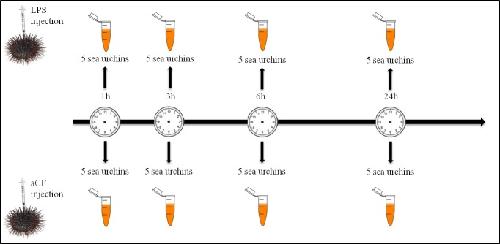
Fig 1. Graphical treatment scheme.A total of 40 animals were divided into eight groups of five animals. Four groups of sea urchins received an injection of 2μg/mL of LPS (treated groups) and the remaining four groups received an injection of aCF (control groups). Coelomocytes from animals of treated and control groups were collected at 1, 3, 6 and 24h.
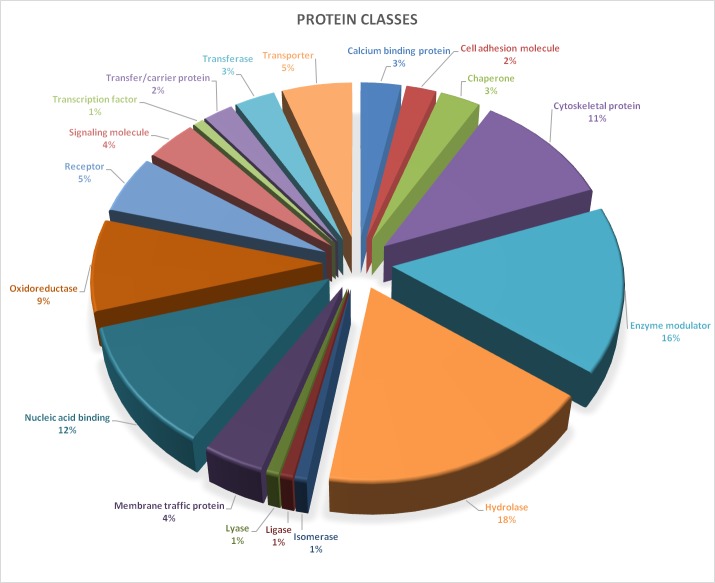
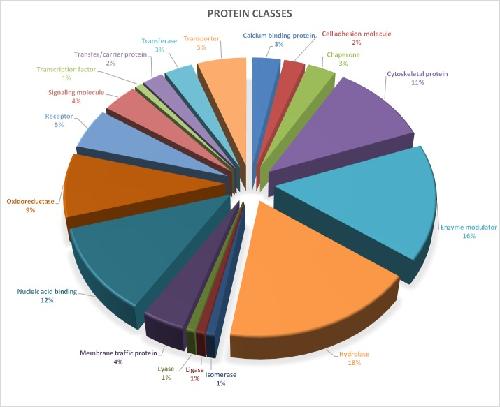
Fig 2. Protein classes identified by mass spectrometry.Proteins identified by Mass Spectrometry were examined using Panther (Protein Analysis through Evolutionary Relationship, Version 13.1). A total of 137 proteins was recognised and divided into eighteen classes: calcium binding protein, cell adhesion molecule, chaperone, cytoskeletal protein, enzyme modulator, hydrolase, isomerase, ligase, lyase, membrane traffic protein, nucleic acid binding, oxidoreductase, receptor, signaling molecule, transcription factor, transfer/carrier protein, transferase, transporter.
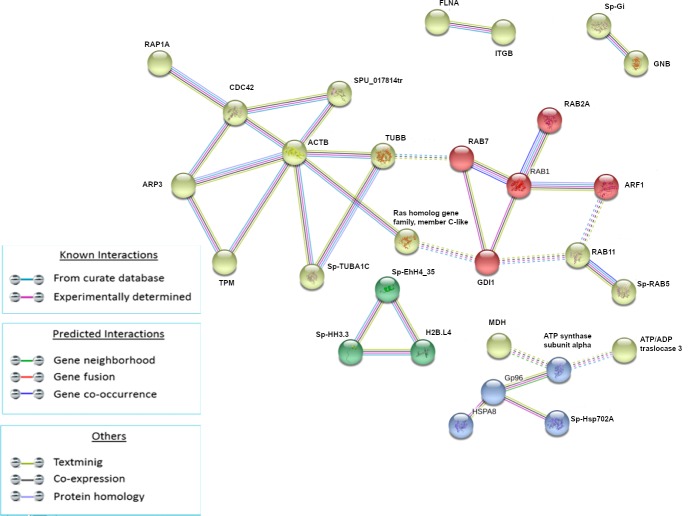
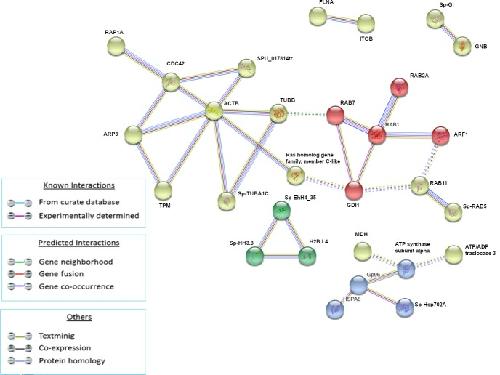
Fig 3. Analysis of known and predicted protein-protein interaction networks at 1 HPLT.Modulated proteins (Fold change >0.5 and <-0.5) were used as input for STRING analysis to reveal known and predicted protein-protein interaction networks. Proteins are indicated by nodes labeled with the encoding gene symbol. Additional cluster analysis was used to colour the nodes of the interaction networks (k-means = 3). The analysis showed the modulation of a network of interaction that was mainly composed of cytoskeleton and cytoskeleton-related factors (yellow cluster), a network mainly composed of RAS superfamily GTPase members (red cluster), a network mainly composed of heat shock proteins (blue cluster) and a network composed of the histone proteins (green network).
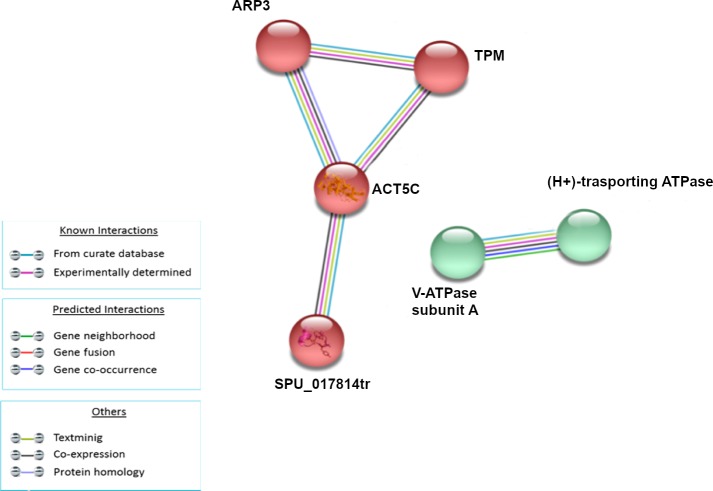
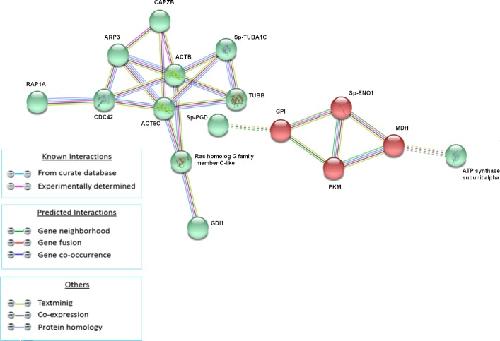
Fig 4. Analysis of known and predicted protein-protein interaction networks at 3 HPLT.Modulated proteins (Fold change >0.5 and <-0.5) were used as input for STRING analysis to reveal known and predicted protein-protein interaction networks. Proteins are indicated by nodes labeled with the encoding gene symbol. Additional cluster analysis was used to colour the nodes of the interaction networks (k-means = 2). The analysis showed the modulation of a network of interaction that was mainly composed of proteins involved in cytoskeleton and RAS signaling (green cluster) and of a second network mainly composed of proteins involved in energetic homeostasis (red cluster).
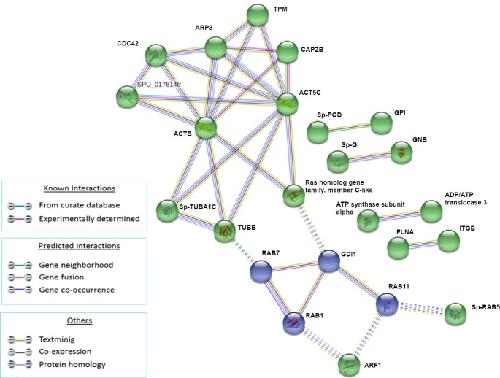
Fig 5. Analysis of known and predicted protein-protein interaction networks at 6 HPLT.Modulated proteins (Fold change >0.5 and <-0.5) were used as input for STRING analysis to reveal known and predicted protein-protein interaction networks. Proteins are indicated by nodes labeled with the encoding gene symbol. Additional cluster analysis was used to colour the nodes of the interaction networks (k-means = 2). The analysis showed the modulation of a network of interaction that was mainly composed of proteins involved in the cytoskeleton organization and RAS GTPases (green cluster), while the latter was composed of RAB proteins specifically involved in vesicles and endosome transport, fusion and recycling.
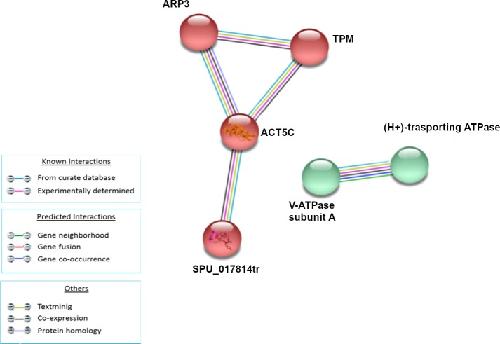
Fig 6. Analysis of known and predicted protein-protein interaction networks at 24 HPLT.Modulated proteins (Fold change >0.5 and <-0.5) were used as input for STRING analysis to reveal known and predicted protein-protein interaction networks. Proteins are indicated by nodes labeled with the encoding gene symbol. Additional cluster analysis was used to colour the nodes of the interaction networks (k-means = 2). The analysis showed the modulation of a network of interaction that was mainly composed of proteins related to cellular cytoskeleton (red cluster).
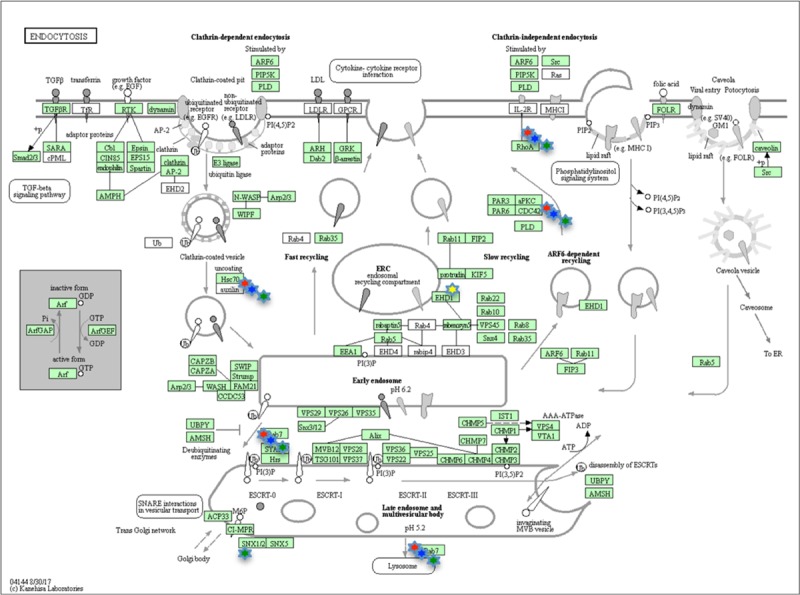
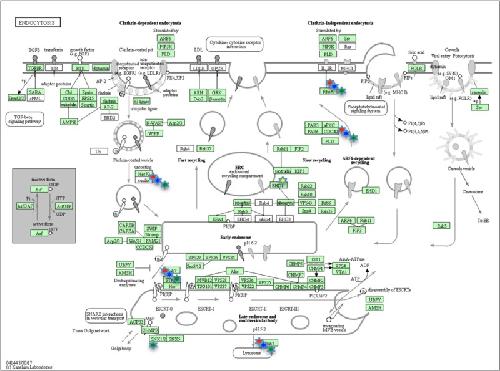
Fig 7. KEGG Endocytosis pathway.Endocytosis pathway as showed by the KEGG database. Proteins in the pathway are depicted by boxes while arrows depict signaling routes. Red stars correspond to modulated proteins, identified by the MS analysis, at 1HPLT (Hours post LPS treatment), blue stars at 3 HPLT, green stars at 6HPLT and yellow stars at 24HPLT.
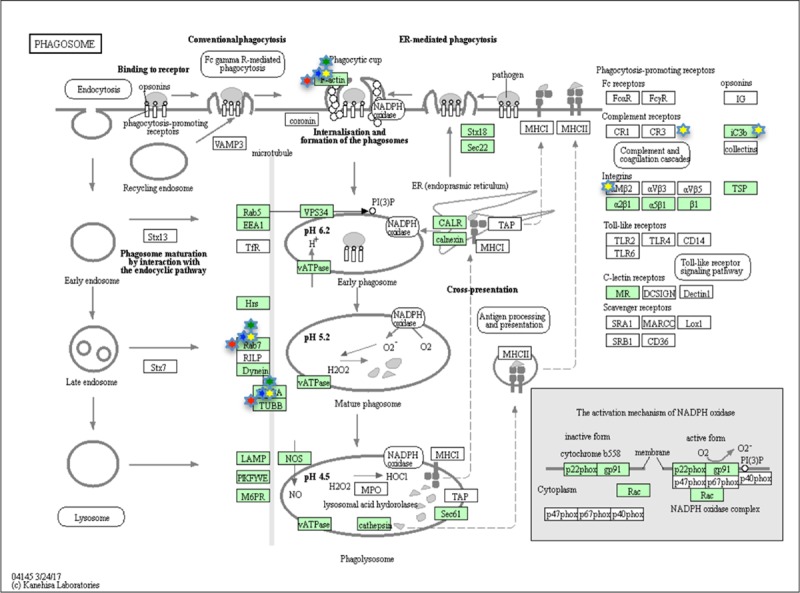
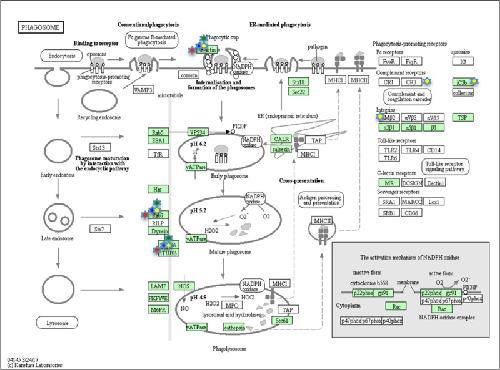
Fig 8. KEGG Phagosome pathway.Phagosome pathway as showed by the KEGG database. Proteins in the pathway are depicted by boxes while arrows depict signaling routes. Red stars correspond to modulated proteins, identified by the MS analysis, at 1HPLT ((Hours post LPS treatment), blue stars at 3 HPLT, green stars at 6HPLT and yellow stars at 24HPLT.
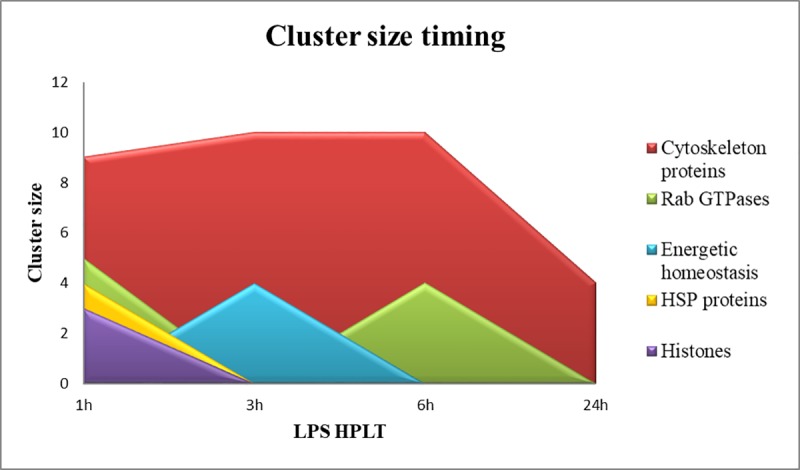
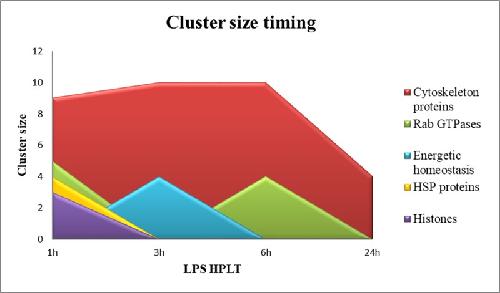
Fig 9. Modulation of the size of clusters during the LPS treatment.Area chart representing the timing profile of cluster sizes in terms of number of STRING nodes, at 1, 3, 6 and 24HPLT for Cytoskeleton proteins (red), RAB GTPases (lime), Energetic homeostasis (light blue), HSP proteins (yellow), Histones (purple).
Ambade,
Inhibition of heat shock protein (molecular weight 90 kDa) attenuates proinflammatory cytokines and prevents lipopolysaccharide-induced liver injury in mice.
2012, Pubmed
Ambade,
Inhibition of heat shock protein (molecular weight 90 kDa) attenuates proinflammatory cytokines and prevents lipopolysaccharide-induced liver injury in mice.
2012,
Pubmed Arizza,
Cell cooperation in coelomocyte cytotoxic activity of Paracentrotus lividus coelomocytes.
2007,
Pubmed
,
Echinobase Arizza,
Gender differences in the immune system activities of sea urchin Paracentrotus lividus.
2013,
Pubmed
,
Echinobase Bayram,
Cross-species proteomics in analysis of mammalian sperm proteins.
2016,
Pubmed Boureux,
Evolution of the Rho family of ras-like GTPases in eukaryotes.
2007,
Pubmed Buckley,
Dynamic evolution of toll-like receptor multigene families in echinoderms.
2012,
Pubmed
,
Echinobase Chiaramonte,
PI3K inhibition highlights new molecular interactions involved in the skeletogenesis of Paracentrotus lividus embryos.
2020,
Pubmed
,
Echinobase Chiaramonte,
Evolutionary conserved pathway of the innate immune response after a viral insult in Paracentrotus lividus sea urchin.
2019,
Pubmed
,
Echinobase Chiaramonte,
Stress and immune response to bacterial LPS in the sea urchin Paracentrotus lividus (Lamarck, 1816).
2019,
Pubmed
,
Echinobase Cox,
MaxQuant enables high peptide identification rates, individualized p.p.b.-range mass accuracies and proteome-wide protein quantification.
2008,
Pubmed Deutsch,
The ProteomeXchange consortium in 2017: supporting the cultural change in proteomics public data deposition.
2017,
Pubmed Dheilly,
Shotgun proteomics of coelomic fluid from the purple sea urchin, Strongylocentrotus purpuratus.
2013,
Pubmed
,
Echinobase Gay,
Structure and function of Toll receptors and their ligands.
2007,
Pubmed Ghosh,
Sp185/333: a novel family of genes and proteins involved in the purple sea urchin immune response.
2010,
Pubmed
,
Echinobase Hirano,
Echinoderm immunity: is the larval immune system immature?
2016,
Pubmed
,
Echinobase Ho,
CR16 forms a complex with N-WASP in brain and is a novel member of a conserved proline-rich actin-binding protein family.
2001,
Pubmed Ho,
Toca-1 mediates Cdc42-dependent actin nucleation by activating the N-WASP-WIP complex.
2004,
Pubmed Jaffe,
Rho GTPases: biochemistry and biology.
2005,
Pubmed Jordens,
Rab proteins, connecting transport and vesicle fusion.
2005,
Pubmed Kanehisa,
KEGG: kyoto encyclopedia of genes and genomes.
2000,
Pubmed Kanehisa,
KEGG: new perspectives on genomes, pathways, diseases and drugs.
2017,
Pubmed Kanehisa,
KEGG as a reference resource for gene and protein annotation.
2016,
Pubmed Liska,
Expanding the organismal scope of proteomics: cross-species protein identification by mass spectrometry and its implications.
2003,
Pubmed Martinez-Quiles,
WIP regulates N-WASP-mediated actin polymerization and filopodium formation.
2001,
Pubmed Mathesius,
Evaluation of proteome reference maps for cross-species identification of proteins by peptide mass fingerprinting.
2002,
Pubmed Matranga,
Monitoring chemical and physical stress using sea urchin immune cells.
2005,
Pubmed
,
Echinobase Mi,
Large-scale gene function analysis with the PANTHER classification system.
2013,
Pubmed Millard,
Signalling to actin assembly via the WASP (Wiskott-Aldrich syndrome protein)-family proteins and the Arp2/3 complex.
2004,
Pubmed Mogensen,
Pathogen recognition and inflammatory signaling in innate immune defenses.
2009,
Pubmed Mostowy,
The cytoskeleton in cell-autonomous immunity: structural determinants of host defence.
2015,
Pubmed Mun,
Regulation of actin cytoskeleton by Rap1 binding to RacGEF1.
2012,
Pubmed Pinsino,
Sea urchin immune cells as sentinels of environmental stress.
2015,
Pubmed
,
Echinobase Romero,
Cell mediated immune response of the Mediterranean sea urchin Paracentrotus lividus after PAMPs stimulation.
2016,
Pubmed
,
Echinobase Russo,
A member of the Tlr family is involved in dsRNA innate immune response in Paracentrotus lividus sea urchin.
2015,
Pubmed
,
Echinobase Satake,
Toll-like receptors of deuterostome invertebrates.
2012,
Pubmed
,
Echinobase Schillaci,
Fragments of β-thymosin from the sea urchin Paracentrotus lividus as potential antimicrobial peptides against staphylococcal biofilms.
2012,
Pubmed
,
Echinobase Schillaci,
Antimicrobial and antistaphylococcal biofilm activity from the sea urchin Paracentrotus lividus.
2010,
Pubmed
,
Echinobase Smith,
Sea urchin genes expressed in activated coelomocytes are identified by expressed sequence tags. Complement homologues and other putative immune response genes suggest immune system homology within the deuterostomes.
1996,
Pubmed
,
Echinobase Smith,
Echinoderm immunity.
2010,
Pubmed
,
Echinobase Spinello,
Antimicrobial and Antibiofilm Activity of a Recombinant Fragment of β-Thymosin of Sea Urchin Paracentrotus lividus.
2018,
Pubmed
,
Echinobase Stabili,
The sea urchin Paracentrotus lividus immunological response to chemical pollution exposure: The case of lindane.
2015,
Pubmed
,
Echinobase Swovick,
Cross-species Comparison of Proteome Turnover Kinetics.
2018,
Pubmed Szklarczyk,
The STRING database in 2017: quality-controlled protein-protein association networks, made broadly accessible.
2017,
Pubmed Szklarczyk,
STRING v10: protein-protein interaction networks, integrated over the tree of life.
2015,
Pubmed Terwilliger,
Distinctive expression patterns of 185/333 genes in the purple sea urchin, Strongylocentrotus purpuratus: an unexpectedly diverse family of transcripts in response to LPS, beta-1,3-glucan, and dsRNA.
2007,
Pubmed
,
Echinobase Triantafilou,
Heat-shock protein 70 and heat-shock protein 90 associate with Toll-like receptor 4 in response to bacterial lipopolysaccharide.
2004,
Pubmed Vazzana,
Cytotoxic activity of Holothuria tubulosa (Echinodermata) coelomocytes.
2018,
Pubmed
,
Echinobase Vazzana,
Underwater high frequency noise: Biological responses in sea urchin Arbacia lixula (Linnaeus, 1758).
2020,
Pubmed
,
Echinobase Vazzana,
Cellular responses and HSP70 expression during wound healing in Holothuria tubulosa (Gmelin, 1788).
2015,
Pubmed
,
Echinobase Vega,
RhoA and RhoC have distinct roles in migration and invasion by acting through different targets.
2011,
Pubmed Vizcaíno,
2016 update of the PRIDE database and its related tools.
2016,
Pubmed Vo,
A Proteome-wide Fission Yeast Interactome Reveals Network Evolution Principles from Yeasts to Human.
2016,
Pubmed von Mering,
STRING: known and predicted protein-protein associations, integrated and transferred across organisms.
2005,
Pubmed Wada,
Reprogramming of metabolism in immune-mediated cells.
2017,
Pubmed Wallin,
Heat-shock proteins as activators of the innate immune system.
2002,
Pubmed Wang,
Proteomic analysis and cross species comparison of casein fractions from the milk of dairy animals.
2017,
Pubmed Wheeler,
Why three Rho proteins? RhoA, RhoB, RhoC, and cell motility.
2004,
Pubmed Wright,
Cross species proteomics.
2010,
Pubmed Zhen,
Cellular functions of Rab GTPases at a glance.
2015,
Pubmed