Click
here to close Hello! We notice that
you are using Internet Explorer, which is not supported by Echinobase
and may cause the site to display incorrectly. We suggest using a
current version of Chrome,
FireFox,
or Safari.
PLoS One
2019 Jan 01;145:e0197644. doi: 10.1371/journal.pone.0197644.
Show Gene links
Show Anatomy links
Identification, structure-activity relationship and in silico molecular docking analyses of five novel angiotensin I-converting enzyme (ACE)-inhibitory peptides from stone fish (Actinopyga lecanora) hydrolysates.
Auwal SM, Zainal Abidin N, Zarei M, Tan CP, Saari N.
???displayArticle.abstract???
Stone fish is an under-utilized sea cucumber with many health benefits. Hydrolysates with strong ACE-inhibitory effects were generated from stone fish protein under the optimum conditions of hydrolysis using bromelain and fractionated based on hydrophobicity and isoelectric properties of the constituent peptides. Five novel peptide sequences with molecular weight (mw) < 1000 daltons (Da) were identified using LC-MS/MS. The peptides including Ala-Leu-Gly-Pro-Gln-Phe-Tyr (794.44 Da), Lys-Val-Pro-Pro-Lys-Ala (638.88 Da), Leu-Ala-Pro-Pro-Thr-Met (628.85 Da), Glu-Val-Leu-Ile-Gln (600.77 Da) and Glu-His-Pro-Val-Leu (593.74 Da) were evaluated for ACE-inhibitory activity and showed IC50 values of 0.012 mM, 0.980 mM, 1.310 mM, 1.440 mM and 1.680 mM, respectively. The ACE-inhibitory effects of the peptides were further verified using molecular docking study. The docking results demonstrated that the peptides exhibit their effect mainly via hydrogen and electrostatic bond interactions with ACE. These findings provide evidence about stone fish as a valuable source of raw materials for the manufacture of antihypertensive peptides that can be incorporated to enhance therapeutic relevance and commercial significance of formulated functional foods.
???displayArticle.pubmedLink???
31145747 ???displayArticle.pmcLink???PMC6542528 ???displayArticle.link???PLoS One
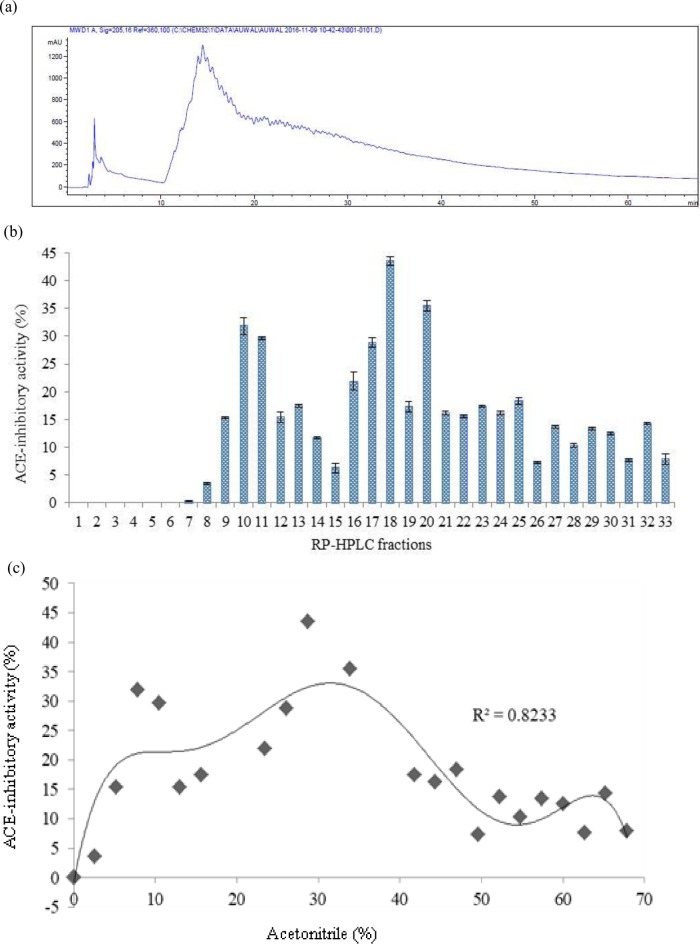
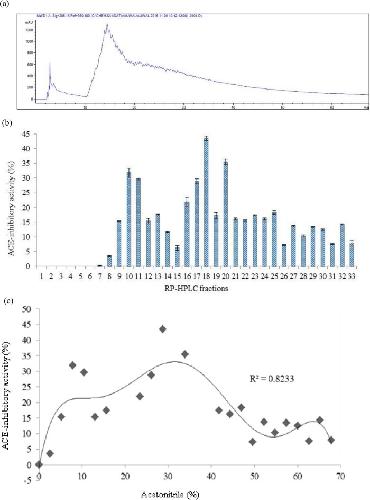
Fig 1. Hydrophobicity-based fractionation of bromelain-generated stone fish protein hydrolysate (a) Chromatogram of semi-preparative RP-HPLC; (b) ACE-inhibitory activities of each of the potent fraction; (c) Relation between ACE-inhibitory activity and percentage acetonitrile being used.
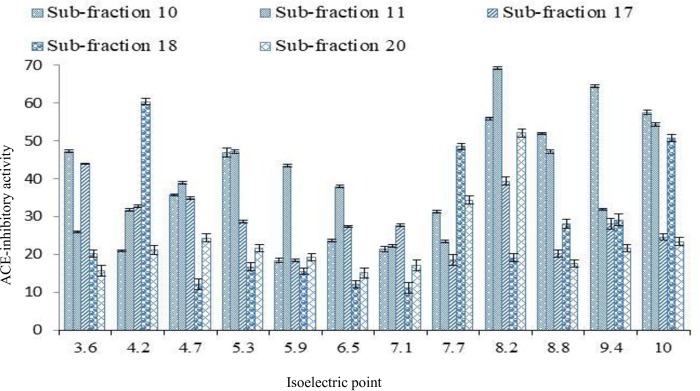
Fig 2. ACE-inhibitory activity of bromelain-generated stone fish protein hydrolysate fractions at different isoelectric points along a pH gradient (3–10).
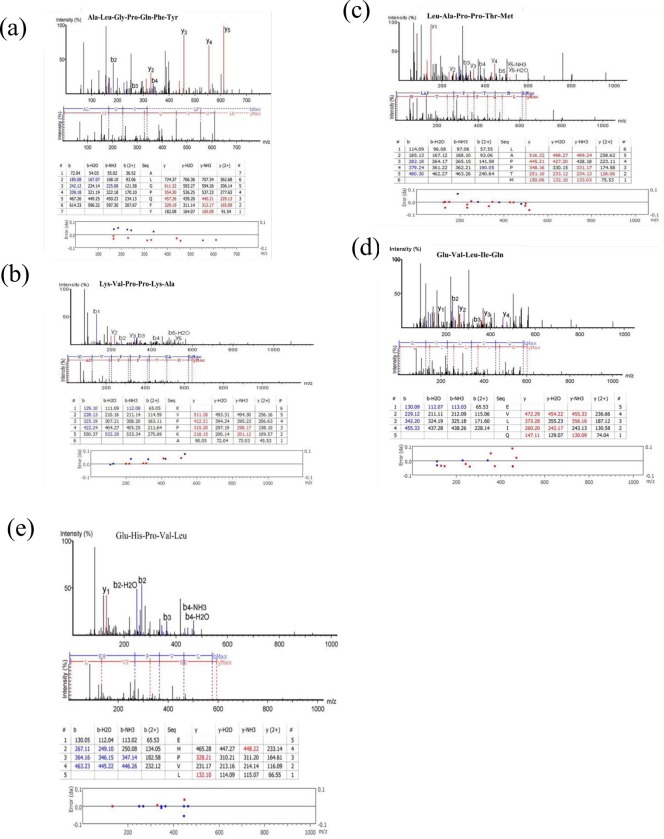
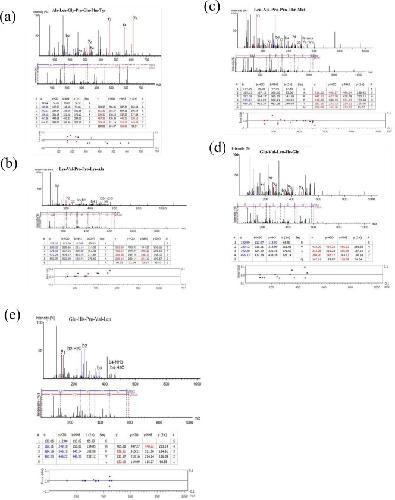
Fig 3. MS/MS spectra, ion tables, MS/MS fragments and standard error of the potent peptide sequences with mw < 1000 Da: (a) Ala-Leu-Gly-Pro-Gln-Phe-Tyr (b) Lys-Val-Pro-Pro-Lys-Ala (c) Leu-Ala-Pro-Pro-Thr-Met (d) Glu-Val-Leu-Ile-Gln (e) Glu-His-Pro-Val-Leu.
Fig 4. Predicted mode of binding of peptides and captopril docked to ACE.(a) Ala-Leu-Gly-Pro-Gln-Phe-Tyr (b) Lys-Val-Pro-Pro-Lys-Ala (c) Leu-Ala-Pro-Pro-Thr-Met (d) Glu-Val-Leu-Ile-Gln (e) Glu-His-Pro-Val-Leu and (f) Captopril. Peptides are indicated as green lines, ACE residues are depicted as ribbon sticks, Different mode of interaction and selected distances are illustrated by dash lines and zinc ions are shown as cyan spheres.
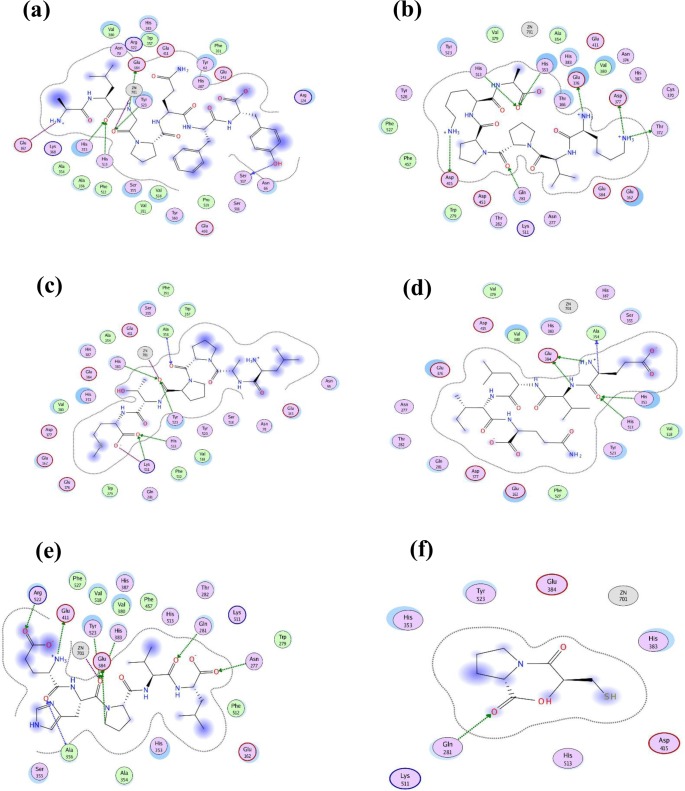
Fig 5. Predicted binding site for the 2D interaction of stone fish-derived ACE-inhibitory peptides with molecular surface of ACE; (a) Ala-Leu-Gly-Pro-Gln-Phe-Tyr (b) Lys-Val-Pro-Pro-Lys-Ala (c) Leu-Ala-Pro-Pro-Thr-Met (d) Glu-Val-Leu-Ile-Gln (e) Glu-His-Pro-Val-Leu and (f) Captopril as predicted by Schrödinger software.
Abdelhedi,
In silico analysis and molecular docking study of angiotensin I-converting enzyme inhibitory peptides from smooth-hound viscera protein hydrolysates fractionated by ultrafiltration.
2018, Pubmed
Abdelhedi,
In silico analysis and molecular docking study of angiotensin I-converting enzyme inhibitory peptides from smooth-hound viscera protein hydrolysates fractionated by ultrafiltration.
2018,
Pubmed Aguilar,
Reversed-phase high-performance liquid chromatography.
2004,
Pubmed Amado,
Identification of the major ACE-inhibitory peptides produced by enzymatic hydrolysis of a protein concentrate from cuttlefish wastewater.
2014,
Pubmed Asoodeh,
Biochemical characterization of a novel antioxidant and angiotensin I-converting enzyme inhibitory peptide from Struthio camelus egg white protein hydrolysis.
2016,
Pubmed Auwal,
Response Surface Optimisation for the Production of Antioxidant Hydrolysates from Stone Fish Protein Using Bromelain.
2017,
Pubmed Bordbar,
High-value components and bioactives from sea cucumbers for functional foods--a review.
2011,
Pubmed
,
Echinobase Chakrabarti,
Food-derived bioactive peptides on inflammation and oxidative stress.
2014,
Pubmed Chay,
Blood-pressure lowering efficacy of winged bean seed hydrolysate in spontaneously hypertensive rats, peptide characterization and a toxicity study in Sprague-Dawley rats.
2018,
Pubmed Cheung,
Binding of peptide substrates and inhibitors of angiotensin-converting enzyme. Importance of the COOH-terminal dipeptide sequence.
1980,
Pubmed Daskaya-Dikmen,
Angiotensin-I-Converting Enzyme (ACE)-Inhibitory Peptides from Plants.
2017,
Pubmed Datta,
Role of Aromatic Amino Acids in Lipopolysaccharide and Membrane Interactions of Antimicrobial Peptides for Use in Plant Disease Control.
2016,
Pubmed Deddish,
Naturally occurring active N-domain of human angiotensin I-converting enzyme.
1994,
Pubmed Friesner,
Extra precision glide: docking and scoring incorporating a model of hydrophobic enclosure for protein-ligand complexes.
2006,
Pubmed Ghanbari,
Angiotensin-I Converting Enzyme (ACE) Inhibitory and Anti-Oxidant Activities of Sea Cucumber (Actinopyga lecanora) Hydrolysates.
2015,
Pubmed
,
Echinobase Girgih,
Kinetics and molecular docking studies of the inhibitions of angiotensin converting enzyme and renin activities by hemp seed (Cannabis sativa L.) peptides.
2014,
Pubmed Hartmann,
Food-derived peptides with biological activity: from research to food applications.
2007,
Pubmed He,
Evaluating molecular mechanism of hypotensive peptides interactions with renin and angiotensin converting enzyme.
2014,
Pubmed Hu,
Antimicrobial activity and safety evaluation of peptides isolated from the hemoglobin of chickens.
2016,
Pubmed Ibrahim,
Novel angiotensin-converting enzyme inhibitory peptides from caseins and whey proteins of goat milk.
2017,
Pubmed Iwaniak,
Food-Originating ACE Inhibitors, Including Antihypertensive Peptides, as Preventive Food Components in Blood Pressure Reduction.
2014,
Pubmed Jimsheena,
Colorimetric, high-throughput assay for screening Angiotensin I-converting enzyme inhibitors.
2009,
Pubmed Jimsheena,
Arachin derived peptides as selective angiotensin I-converting enzyme (ACE) inhibitors: structure-activity relationship.
2010,
Pubmed Kim,
Angiotensin I converting enzyme inhibitory peptides purified from bovine skin gelatin hydrolysate.
2001,
Pubmed Lee,
Characterization of bioactive peptides obtained from marine invertebrates.
2012,
Pubmed Lee,
Antihypertensive peptides from animal products, marine organisms, and plants.
2017,
Pubmed Li,
Identification of Angiotensin I-Converting Enzyme Inhibitory Peptides Derived from Enzymatic Hydrolysates of Razor Clam Sinonovacula constricta.
2016,
Pubmed Li,
Purification of a novel angiotensin I-converting enzyme (ACE) inhibitory peptide with an antihypertensive effect from loach (Misgurnus anguillicaudatus).
2012,
Pubmed Manoharan,
STRUCTURAL CHARACTERISTICS AND ANTIHYPERTENSIVE EFFECTS OF ANGIOTENSIN-I-CONVERTING ENZYME INHIBITORY PEPTIDES IN THE RENIN-ANGIOTENSIN AND KALLIKREIN KININ SYSTEMS.
2017,
Pubmed Mirzaei,
Production of antioxidant and ACE-inhibitory peptides from Kluyveromyces marxianus protein hydrolysates: Purification and molecular docking.
2018,
Pubmed Moayedi,
ACE-Inhibitory and Antioxidant Activities of Peptide Fragments Obtained from Tomato Processing By-Products Fermented Using Bacillus subtilis: Effect of Amino Acid Composition and Peptides Molecular Mass Distribution.
2017,
Pubmed Natesh,
Crystal structure of the human angiotensin-converting enzyme-lisinopril complex.
2003,
Pubmed Qiao,
Discovery of Anti-Hypertensive Oligopeptides from Adlay Based on In Silico Proteolysis and Virtual Screening.
2016,
Pubmed Rocha,
Potential antioxidant peptides produced from whey hydrolysis with an immobilized aspartic protease from Salpichroa origanifolia fruits.
2017,
Pubmed Shi,
Isolation, purification and molecular mechanism of a peanut protein-derived ACE-inhibitory peptide.
2014,
Pubmed Sturrock,
Structure of angiotensin I-converting enzyme.
2004,
Pubmed Sun,
Separation and Characterization of Angiotensin I Converting Enzyme (ACE) Inhibitory Peptides from Saurida elongata Proteins Hydrolysate by IMAC-Ni2.
2017,
Pubmed Udenigwe,
Food protein-derived bioactive peptides: production, processing, and potential health benefits.
2012,
Pubmed Wang,
Characterization, Preparation, and Purification of Marine Bioactive Peptides.
2017,
Pubmed Yea,
Winged bean [Psophorcarpus tetragonolobus (L.) DC] seeds as an underutilised plant source of bifunctional proteolysate and biopeptides.
2014,
Pubmed Yousr,
Antioxidant and ACE Inhibitory Bioactive Peptides Purified from Egg Yolk Proteins.
2015,
Pubmed Zhu,
Isolation and identification of antioxidant peptides from jinhua ham.
2013,
Pubmed